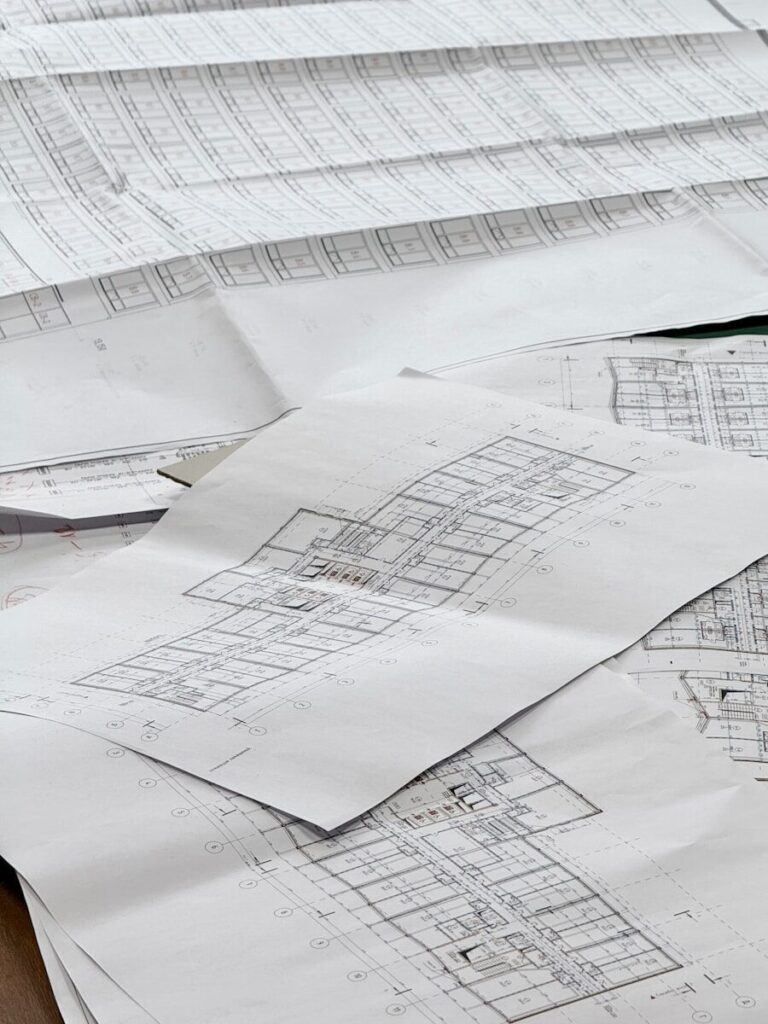
Blueprint printing has a fascinating history spanning nearly two centuries. At RK Reprographics, we’ve watched the industry transform from cyanotype chemistry to digital inkjet systems. Understanding the evolution of blueprint printing helps us appreciate the modern technology we use daily and contextualizes why construction still relies on printed documents despite digital alternatives.
Industry standards for construction documentation are maintained by organizations like the American Institute of Architects.
The Cyanotype Era (1842-1920s)
The original blueprint process, invented by John Herschel in 1842, used a chemical reaction between ferric salts and potassium ferrocyanide. The name “blueprint” comes directly from this era—the paper literally turned blue when exposed to light.
The Process – Paper was coated with light-sensitive chemicals, placed against the drawing, exposed to sunlight, then washed to develop the image
Advantages – Simple, reliable, inexpensive to produce once coated
Disadvantages – Slow (required significant sunlight exposure), produces blue prints with white lines (opposite of what architects prefer), difficult to reproduce at scale
Historical Impact – Revolutionized architecture and engineering by providing an affordable way to create multiple copies of technical drawings
Cyanotype remained the standard for construction drawings well into the 20th century. The blue-on-white aesthetic is so iconic that people still sometimes call technical drawings “blueprints” even when they’re not blue.
Diazo and Ozalid Processes (1920s-1980s)
The diazo process, developed in the 1920s, became the dominant reprographic technology for decades. It allowed both positive and negative prints, with better clarity than cyanotype.
The Process – Light-sensitive diazo compounds on paper exposed to UV light through a master drawing, then developed with ammonia vapor
Advantages – Produced black lines on white background (preferred by architects), faster than cyanotype, more consistent quality, could create multiple line weights
Disadvantages – Required UV light boxes and ammonia development (strong smell), limited to black-and-white, slow by modern standards
Cultural Impact – The distinctive ammonia smell became synonymous with reprographics offices; a whole generation of architects and engineers worked in pungent-smelling plan rooms
Diazo dominated so thoroughly that the mid-20th century saw thousands of reprographics shops with rows of UV exposure boxes and ammonia developers. The transition away from diazo in the 1990s upended the entire reprographics industry.
Electrostatic Copiers and Plotters (1970s-1990s)
As photocopier technology advanced, large-format electrostatic plotters emerged. These machines used electrostatic charge and dry toner similar to office copiers.
Advantages – No chemical smell, instant dry output, ability to produce color, faster than diazo for high volumes
Disadvantages – Expensive equipment, complex maintenance, color capability limited initially, line quality not as sharp as diazo
Market Transition – Electrostatic systems gradually replaced diazo but never completely dominated because diazo was so entrenched
The 1980s and 1990s saw reprographics shops with both diazo equipment (legacy but still profitable) and new electrostatic systems. Forward-thinking firms invested in new technology; conservative firms eventually had to abandon their ammonia developers.
Early Inkjet Large-Format Printing (1990s-2000s)
Inkjet technology, proven in office printing, began scaling to large format in the 1990s. The transition was slow because diazo was deeply entrenched.
Early Limitations – Color washout, slow printing, expensive ink, limited media options, frequent clogs
Gradual Improvements – Pigment-based inks developed, printheads became more reliable, software improved dramatically
Turning Point (2000s) – Inkjet finally surpassed diazo on quality, speed, and cost per page; diazo systems rapidly became obsolete
The shift from diazo to inkjet was the most disruptive technology change in reprographics history. Firms with decades of ammonia-based equipment suddenly had to completely reinvest in new systems or go out of business.
Modern Wide-Format Inkjet (2000s-Present)
Today’s large-format inkjet systems represent mature technology that has evolved continuously.
Color Capability – Full CMYK color standard; extended color sets (8-12 colors) for specialized applications
Speed and Efficiency – Modern printers produce D-size prints in under a minute; automated systems reduce operator input
Media Flexibility – Works with virtually any paper type: bond, vellum, coated, synthetic, specialty materials
Quality Consistency – Digital controls and calibration ensure remarkably consistent output
Modern inkjet printing dominates construction reprographics globally. RK Reprographics operates exclusively with this technology because it best serves our clients’ needs.
The Rise of Digital Alternatives
The last decade has seen the rise of digital project delivery, BIM, and cloud-based plan rooms. Many predicted the end of printed documents entirely.
Digital Advantages – Instant delivery, searchable, version control, no physical storage needs
Why Printing Persists – Jobsite conditions (dust, moisture), offline access needs, liability (print creates legal record), contractor preferences, accessibility issues with digital tools
Hybrid Reality – Most firms now use both digital and printed documents, recognizing each has appropriate use cases
Rather than replacing printing, digital distribution has complemented it. Construction still needs physical plans on jobsites, and printed documents provide tangible evidence of what work was supposed to be done.
Looking Forward: Emerging Technologies
Several emerging technologies could reshape the evolution of blueprint printing again:
3D Printing – Could produce physical scale models from CAD; complementary rather than replacement for 2D prints
Interactive/Smart Printing – QR codes and embedded data connecting prints to digital information
Improved Archival Inks – Longer-lasting prints using new pigment chemistry
Hybrid Systems – Combining printing with digital integration on a single device
The history of blueprint printing teaches us that technology changes, but the need for accurate technical documentation persists. Whatever forms future printing takes, the fundamental role—creating reliable records of design intent—will remain.
Frequently Asked Questions
Why are old blueprints blue?
Because cyanotype chemistry produced blue color. Modern “blueprints” are usually black-on-white inkjet prints.
Did ammonia smell indicate quality?
No. The smell was an unavoidable byproduct of the diazo process. Stronger smell didn’t mean better prints.
Are old printing techniques still used?
Cyanotype is occasionally used for artistic purposes, but not commercially. Diazo is essentially extinct. Inkjet has completely dominated since the 2000s.
Will digital completely replace printed documents?
Unlikely. Printed documents persist because they serve functions digital documents don’t: offline availability, legal documentation, jobsite durability. Both will coexist.
RK Reprographics represents the modern era of the evolution of blueprint printing. We’ve adopted the latest technology while respecting the important role printing plays in construction. Contact us to discuss your printing needs.
For more information about construction document services, visit our complete guide to reprographics.