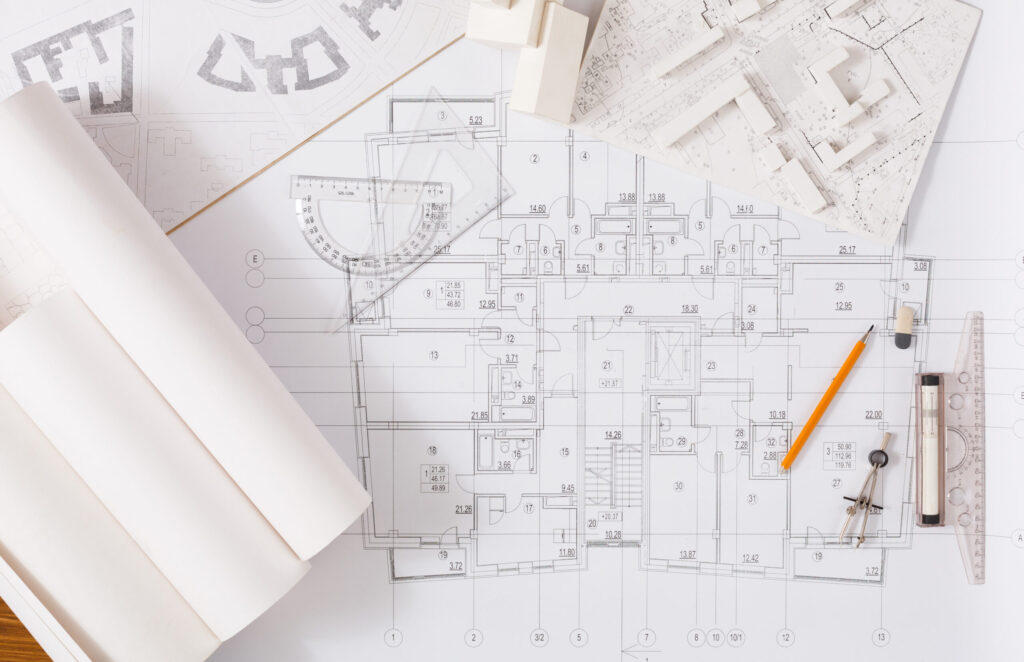
How reprographics works is a question that many construction professionals never think to ask until they need blueprints printed on a tight deadline. Understanding how reprographics works helps architects, engineers, and contractors communicate more effectively with their print providers, avoid common delays, and ensure the highest quality results for their construction documents.
Industry standards for construction documentation are maintained by organizations like the American Institute of Architects.
Modern reprographics combines digital file management, precision printing technology, and construction industry expertise into a streamlined workflow. Whether you are ordering a single permit set or distributing hundreds of drawing packages across multiple job sites, the underlying process follows the same fundamental steps. At RK Reprographics, we’ve refined this workflow to deliver consistent, high-quality results while meeting aggressive project timelines.
Step 1: File Preparation and Submission
The reprographic process begins when an architect, engineer, or contractor submits drawing files to a reprographic service provider. In today’s digital workflow, this typically means uploading CAD files (DWG, DXF, DGN), PDF files, or high-resolution image files to the provider’s online ordering portal or FTP server.
File preparation is critical to the quality of the final output. Drawings should be formatted at the correct scale, with all fonts embedded, external references resolved, and layers organized logically. Many reprographic providers offer preflight checks that automatically scan uploaded files for common issues like missing fonts, out-of-bounds geometry, incorrect paper size settings, or color spaces that won’t reproduce correctly.
Step 2: Print Configuration and Proofing
Once files are received, the reprographic technician configures the print job based on the client’s specifications. This includes selecting the output size, paper type, print mode, and quantity. Scale accuracy is verified at this stage. The technician may print a test sheet and measure known dimensions with a scale ruler to confirm that the output matches the intended scale exactly.
For critical applications like permit submissions or bid packages, technicians often generate a single proof copy for the client to review before starting full production.
Step 3: How Reprographics Works in Printing and Reproduction
The actual printing happens on large-format wide-format plotters or production-grade laser printers, depending on the output type. Modern reprographic equipment incorporates sophisticated color management systems that ensure consistent output regardless of paper type or environmental conditions. Professional reprographic equipment undergoes regular calibration to maintain dimensional accuracy, typically holding tolerances of plus or minus 0.1 percent across the full width of the print.
Step 4: Quality Control and Verification
After printing, each set undergoes rigorous quality control checks. The technician verifies that all sheets are present, correctly ordered, and free of defects. Scale accuracy is spot-checked by measuring reference dimensions on selected sheets. Color prints are compared against reference standards to ensure consistency across the set.
Step 5: Finishing and Assembly
Depending on client requirements, printed sheets may undergo various finishing processes. The most common is folding—construction drawings are typically folded to a standard 9 by 12 inch package that fits in a standard filing system or can be shipped in a flat mailer. Machine folding produces consistent, professional results, though hand-folding is sometimes necessary for unusual sheet sizes.
Other finishing options include binding (comb binding, coil binding, or three-ring punching for specification books), collating multiple sets, tabbing section dividers, and packaging for shipping or distribution.
Step 6: Distribution and Delivery
The final step in how reprographics works is getting the finished documents to the people who need them. Reprographic providers offer multiple distribution options including local pickup, local delivery, and nationwide shipping via commercial carriers.
For large projects with multiple contractors and consultants, the reprographic shop may handle distribution of different sets to different locations according to the client’s distribution matrix. Digital plan rooms complement physical distribution by providing online access to the same documents, allowing team members to reference drawings digitally while physical sets are in transit.
Frequently Asked Questions
How long does the reprographic process take from file to finished prints? Standard turnaround is typically 24-48 hours for most orders. Rush services can produce finished prints same-day for orders submitted by early afternoon.
What file formats work best for reprographic printing? PDF is the preferred format because it preserves all formatting, fonts, and layer information. CAD files (DWG, DXF) also work well but may require conversion before printing.
How do I ensure my prints are dimensionally accurate? Submit files at the correct scale, verify paper size settings match your intended output size, and always request a proof or test print for critical documents.
Professional Reprographic Services
At RK Reprographics, we’ve served construction firms throughout the region for years, developing deep expertise in how reprographics works across diverse project types and requirements. We’re committed to being more than a vendor—we’re a partner supporting your project success through expert, reliable service.
For more information about construction document services, visit our complete guide to reprographics.