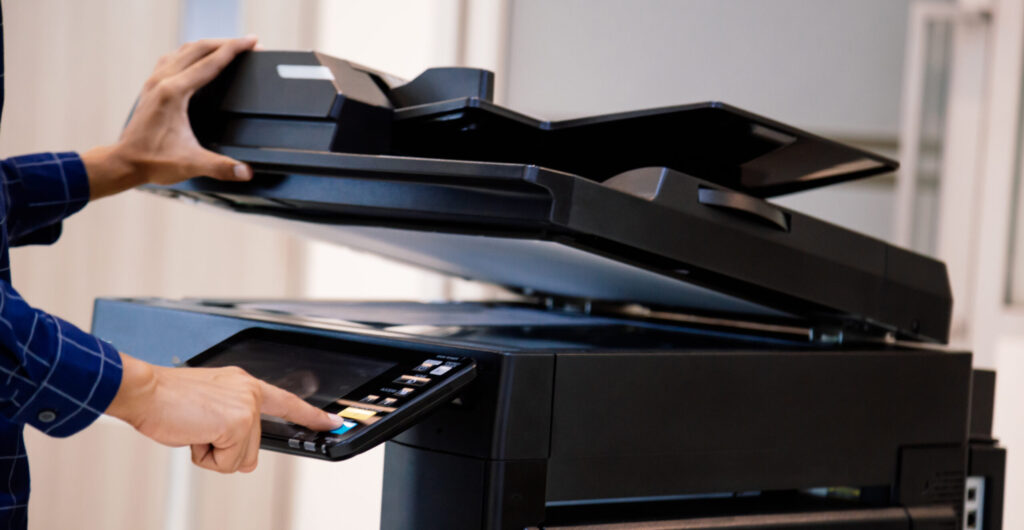
Large-format printing is the technology and process of printing documents, images, and graphics on paper, vinyl, or other media in sizes larger than standard 8.5 x 11″ office paper. Also called wide-format printing or plotter printing, large-format technology is the engine behind construction blueprints, architectural renderings, site plans, engineering drawings, posters, banners, and specialized graphics used across industries.
Understanding what large-format printing is, what it can do, and how it differs from conventional printing helps you make informed decisions about which output technology fits your specific needs.
The Technology Behind Large-Format Printing
Large-format printers are sophisticated machines that extend printing capability beyond the small format of standard office printers. While typical office printers handle paper widths up to 8.5 inches, large-format printers handle media from 18 inches to 64 inches or wider.
Print Heads and Ink Systems
Modern large-format printers use either inkjet technology or LED toner technology. Inkjet systems spray millions of tiny ink droplets onto media to create images. LED toner systems apply dry toner particles to media using electrostatic attraction, similar to color photocopiers but at much larger scale.
Inkjet systems dominate large-format printing. They use either dye-based inks (vibrant colors, good for photographic images) or pigment-based inks (fade-resistant, good for archival documents). Pigment-based inks are preferred for construction documents because they resist fading and maintain color accuracy over decades.
Media Handling
Large-format printers feed media in two configurations: roll-fed and sheet-fed. Roll-fed systems accept continuous paper rolls, allowing unlimited length output. Sheet-fed systems accept pre-cut sheets up to the maximum width of the printer. Both approaches have advantages depending on volume, sheet size, and media type.
Roll-fed systems are economical for high-volume production and allow any length output, making them ideal for long drawing sets and bulk printing. Sheet-fed systems offer flexibility for mixed-size orders and special media (coated paper, vinyl, fabric) that are often available only in sheets.
Width Capabilities
Large-format printer widths determine maximum output width:
24″ wide: ARCH D construction documents (24 x 36″)
36″ wide: ARCH E documents (36 x 48″) and larger
42″ to 64″ wide: Poster-size graphics, oversized site plans, banners
The width capability of a printer is its defining characteristic. A 36″-wide printer is called a 36-inch large-format printer, reflecting its maximum media width.
Standard Sizes and Applications
Large-format printing is measured in standard paper sizes defined by the American National Standards Institute (ANSI) and International Organization for Standardization (ISO).
ARCH Series (Architecture): – ARCH A: 9 x 12″ – ARCH B: 12 x 18″ – ARCH C: 18 x 24″ – ARCH D: 24 x 36″ (most common for construction documents) – ARCH E: 36 x 48″ (used for large site plans and complex drawings) – ARCH E1: 30 x 42″ (less common variant)
Engineering Series (E): – E0: 28 x 40″ (original standard, less common now) – E1: 30 x 42″ – E2: 34 x 44″ – E3: 36 x 48″ – E4: 40 x 52″
ISO Series (A and B): A0 through A6 (ISO metric standard), B0 through B6 (ISO metric standard).
Construction industries typically use ARCH series sizes because they’re optimized for construction documents. Engineering and GIS applications may use engineering series sizes.
Color Capability
Large-format printing produces full color using CMYK (cyan, magenta, yellow, black) color technology. Some specialty systems add additional colors like light cyan and light magenta for superior photographic color gradation. Color-capable large-format printers apply multiple ink colors in precise registration to create any color in the visible spectrum.
Monochrome printing uses only black ink, reducing cost and production time. Most large-format printing environments can output either color or monochrome on demand.
Resolution and Quality
Large-format printer resolution is measured in dpi (dots per inch). Common resolutions are:
600 dpi: Acceptable for construction drawings and basic graphics
1200 dpi: Good quality for most applications
1440 dpi or higher: Photographic quality, suitable for presentations and renderings
Higher resolution produces finer detail and smoother color gradients but requires longer printing time and more ink. Construction documents typically use 600-1200 dpi, providing excellent quality while maintaining reasonable production speed.
Paper and Media Types
Large-format systems accept a variety of media:
Bond paper: Standard white paper used for construction documents. 20-24 lb bond is typical. Economical and widely used.
Coated paper: Premium paper with a smooth coating that enhances color fidelity and sharpness. 100-150 lb premium coated is standard for presentation-quality output.
Matte paper: Non-glossy paper that reduces glare and provides a professional appearance suitable for presentations and client deliverables.
Vinyl: Durable synthetic media for outdoor graphics and signage. Water-resistant and fade-resistant.
Canvas: Textile media for fine art reproduction and specialty graphics. Creates gallery-quality appearance.
Transparent films: Clear or frosted films for overlays and technical applications.
Advantages of Large-Format Printing
Large-format printing offers distinct advantages for specific applications:
Economies of scale for construction documents: Printing full-size construction documents at once is more economical than tiling small prints together.
Quality: Large-format systems produce superior line clarity and color accuracy compared to multiple small-format prints.
Efficiency: Printing one large document is faster than printing and collating multiple smaller documents.
Specialty media: Large-format systems accommodate specialized papers, vinyl, and films that standard printers cannot handle.
Professional appearance: Large-format output on premium media produces presentation-quality documents that enhance professional perception.
Comparison with Standard Office Printing
Standard office printers are designed for high-volume, small-format, low-cost document production. They excel at producing thousands of letters, forms, and reports efficiently. Large-format printing is designed for lower-volume, large-format, specialty output.
The comparison isn’t whether one is “better”—they serve different purposes. Standard printing is more economical for small documents in bulk quantities. Large-format printing is necessary for anything larger than standard paper or requiring specialty media.
Applications Across Industries
Construction and architecture rely heavily on large-format printing for construction drawings, site plans, and presentation renderings. Engineering uses large-format printing for mechanical drawings, electrical schematics, and system diagrams. GIS professionals print large-format maps for planning and environmental applications. Marketing and advertising use large-format printing for posters, banners, and promotional graphics. Facilities management prints large-format floor plans and building diagrams.
In-House vs. Outsourced Large-Format Printing
Many organizations operate their own large-format printers for convenience and speed. Outsourcing to professional reprographic services like RK Reprographics offers advantages including higher quality, faster turnaround on complex color work, access to specialty media, and elimination of equipment maintenance costs.
The decision depends on printing volume, complexity, and budget. Organizations that print frequently and need basic black-and-white line work benefit from in-house equipment. Organizations with variable demand, color requirements, or specialty needs often benefit from outsourcing.
The Future of Large-Format Printing
Large-format printing technology continues evolving. Newer systems include UV-curable ink systems that bond directly to media without requiring drying time, allowing immediate finishing. Latex-based ink systems reduce environmental impact. Expanded color gamuts produce superior photographic quality. Digital workflow integration reduces file handling and improves efficiency.
The core technology—inkjet or toner-based systems applying ink or toner to wide-format media—will remain the standard for large-format printing for the foreseeable future.
Frequently Asked Questions
What’s the difference between large-format and wide-format printing?
The terms are used interchangeably in the industry. “Large-format” emphasizes the size of output. “Wide-format” emphasizes the width capability of the printer. Both refer to the same technology and category of equipment.
Can I print anything I want on large-format equipment?
Most things, with some limitations. The equipment can accept media up to its maximum width, any length (for roll-fed systems), and various material types. Specialty media (vinyl, canvas, fabric) may require specific printer models equipped for non-standard media.
How fast is large-format printing?
Printing speed depends on resolution, color complexity, and media. A monochrome ARCH D drawing at 600 dpi prints in 30-60 seconds. The same drawing in color takes 2-4 minutes. Larger sizes or higher resolutions take longer.
What’s the lifespan of large-format prints?
Pigment-based ink prints on archival bond paper remain vibrant for 25+ years under normal indoor storage. Dye-based inks fade faster. Proper storage (away from direct sunlight and extreme temperature) extends lifespan significantly.
Is large-format printing expensive?
Large-format printing is economical for large documents but more expensive per square inch than standard printing. For construction documents, the economy of printing full-size in a single pass justifies the cost. For small documents, tiling multiple small prints would be less economical than large-format output. See our large format printing or contact us. Resources at printing.org.